CCLab’s Research Pillars
CCLab structures its long-term net-zero transformation agenda around four interrelated thematic pillars, developed in dialogue with the European Green Deal and the New European Bauhaus Initiative of the European Union. These pillars frame the lab’s research, design, and implementation efforts toward advancing spatial justice and inclusive net-zero transitions:
1. Net-Zero Public Space and Social Value: Reframing public space as a key site of value creation in net-zero transitions. This pillar investigates how tangible features (e.g. uses, form, variety, legibility) and experiential qualities (e.g. soundscape, perceived safety, thermal comfort) of the built environment shape lived experience, well-being and social sustainability, and how these dimensions influence engagement, stewardship and the perceived legitimacy of net-zero transitions.
2. Community- Centred Energy Transitions: Advancing participatory governance models that place communities at the center of net-zero transformations. This initiative co-develops inclusive decision-making frameworks that address energy vulnerability, foster collective agency, and strengthen social cohesion in transition processes.
3. Digital Participation and Spatial Intelligence: Designing and testing digital and hybrid governance tools that expand accessibility, representation and trust in net-zero transitions. This initiative integrates behavioural insights, fairness metrics, and socio-technical data infrastructures to support evidence-based, accountable and equitable transformation pathways.
4. University Campuses as Living Labs: Positioning campuses as primary settings for developing and testing innovative spatial and governance methodologies, integrated directly into teaching and research. This pillar advances knowledge transfer by translating tested approaches from the campus environment to urban neighbourhoods, enabling scalable, equitable, and climate-response transformation.
CCLab welcomes researchers and practitioners to join its collaborative platform and actively contribute to the advancement of its four strategic pillars.
Networks
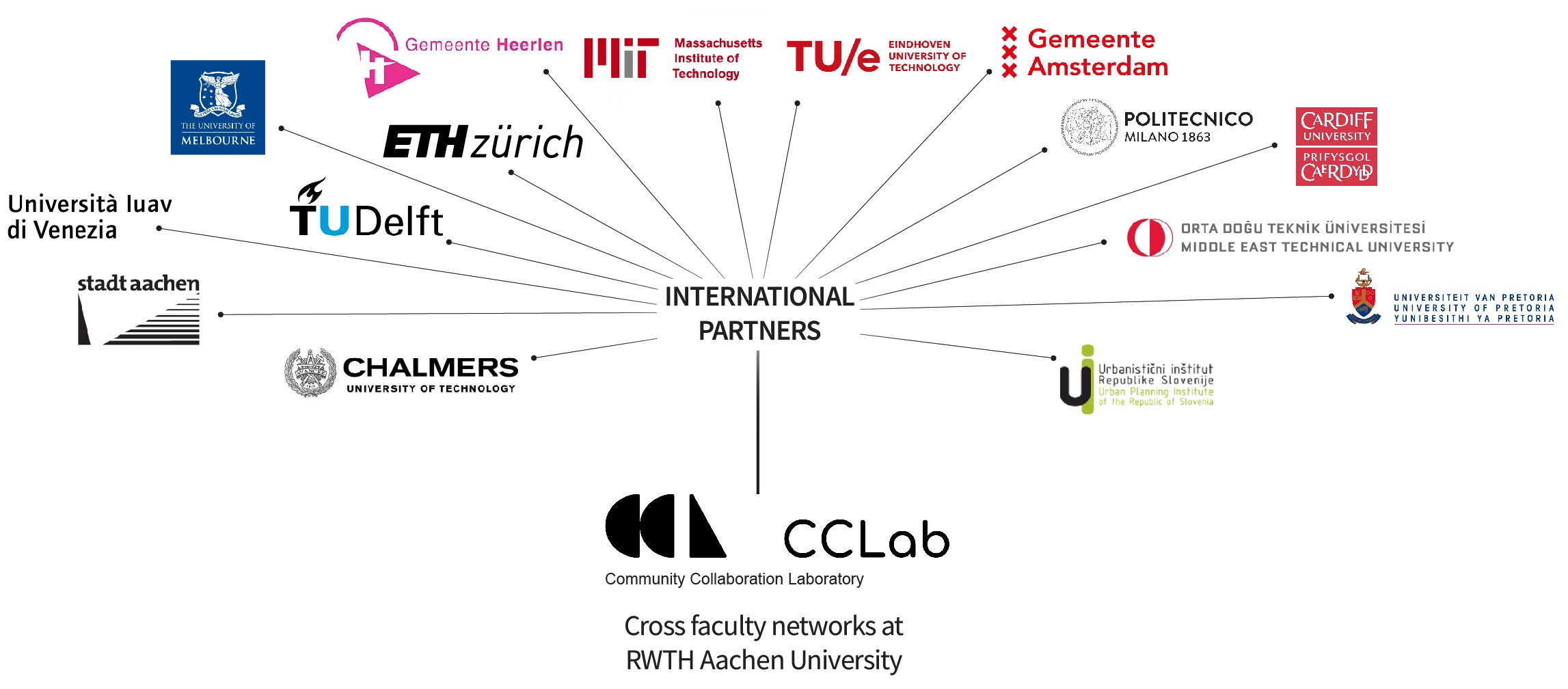
The CCLab builds on its international network at the intersection of net-zero transitions, spatial justice, public space and campus transformation. It facilitates cross-faculty collaboration by connecting spatial design, social theory and governance, energy systems engineering, and digital and hybrid technologies. Through joint design studios, collaborative research projects, co-authored publications, and academic exchange programs, the lab works closely with academic, municipal, and civil society partners to shape inclusive, low-carbon futures.
CCLab closely collaborates with the IDEA League working group on Sustainable Campus Transformation. The lab initiated and co-developed with its partner institutions two international summer schools, a campus sustainability conference and an international exhibition presented as part of the International Architecture Exhibition – La Biennale di Venezia.
 © Heike Lachmann
IDEA League rectors, sustainability coordinators, and sustainability researchers during the Sustainability Conference in Aachen 2022